- Source column 8, spans 15 columns
Crimes comitted by the former revolutionary leaders after 1965
- Source column 1, spans 27 columns
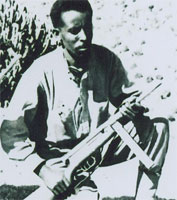
Following the liquidation of the military wing of the ELM, a number of ELM members joined the ELF (Sherman, 1980:42) Seyoum []. To mention a few of them:Saleh Eyay, Tuku etc.
- Source column 17, spans 2 columns, spans 2 rows

- Source column 1, spans 3 columns, spans 4 rows
- Source column 5, spans 4 columns

- Source column 10, spans 2 columns

- Source column 14

- Source column 21, spans 4 columns

- Source column 5, spans 4 columns
Tiku Yihdego
- Source column 10, spans 2 columns, spans 2 rows
Mahmmod Ismael Al-Haj
- Source column 13, spans 3 columns, spans 2 rows
Teklay Haraka
- Source column 17, spans 2 columns, spans 2 rows
Saleh Eyay
- Source column 21, spans 3 columns, spans 2 rows
Mehari Debessai
- Source column 1, spans 5 columns
Mohammed Burhan Nagash
- Source column 1, spans 25 columns
By the middle of 1965, the number of fighters in the ELF had increased from 800 fighters in 1964 to 2,000. This was because of the following factors: 1. A three-day strike of secondary school students in Asmara from March 8-12 , 1965 which caused about 2, 000 students to be detained on the outskirts of Asmara ( Ammar, 1997: 71). Many of those who participated in the strike joined the ELF in that year.
2. After the liquidation of the military wing of the ELM in 1965,many members of Haraka joined the ELF without trying to revitalize its organization. Gebre-Medhin (1989:171) states that with the demise of Harakat (Mahber Shewate) workers and intellectuals who had belonged to it turned to open resistance. He adds that in a matter of a few years the social composition of the fighting forces began to change. Pool (2001:52) and Ammar (1997:75) also point out that most of those who joined the ELF army in the mid-1965 came from the Christian and Muslim population who were better educated, or workers who were Harakat members but their arrival created tension and conflict in the organization. The conflict arose between the new comer who were used to be a member of Haraka, Young Federalists, Muslim Youth, Teacher Association and the banned trade union who belief that belief that “Muslims and Christians are brothers, and their unity makes Eritrea one, and ELF leaders who hated ELM because of their secular (Iyob, 1995:102).
According to Breaketeab(2000:184) Idris Mohammed Adem in particular, dislike the stretegy of the ELM to broaden its organisation through recuriting Christians. Because of this attitude of the ELF founder leaders, the ELF was founded on fostered religious antagonism and fanned backward differences and sentiments, of a regional and ethnic nature which is still left some its trace among the leader of the opposition groups. The Supreme Council of the ELF leadership also instead of working for the unity of the Eritrean Liberation Army deliberately divided it by region and ethnicity through establishing five military zones based on a territorial division
- Source column 1, spans 26 columns
In 1965 when the Supreme Council of the ELF divided the Eritrean Liberation Army into five zones, Ato Woldeab and Ato Ibrahim were concerned at its consequences and both of them sent a message of unity and reconciliation to the Eritrean Liberation Army. This period (1965-1968) of division in the history of the Eritrean armed struggle is called Zemene Kiflitat
- Source column 3, spans 21 columns
This is an excerpt from what Ato Woldeab wrote when Ato Ibrahim died
- Source column 3, spans 17 columns
Do you remember in 1965, when our revolutionary children became splintered into five factions because of the evil machinations of their leaders and that this division was deteriorating into a civil war that caused us much alarm and concern and that we went to discuss the matter with our Syrian friends to Damascus where they gave us a warm welcome and arranged for us to transmit our advice to our revolutionary children by radio, and that we, you in Tigre and myself in Tigrigna, managed to send our message of unity and reconciliation?Read more
- Source column 1, spans 25 columns
Despite of the above message, the regional-based military structure had created mutual suspicion and hatred among the fighters and its consequence can be seen from the examples below.
- Source column 1, spans 26 columns
For example, Osman Hishal, deputy commander of the fifth zonal division, summarily executed twenty-seven Christian fighters alleging either poor performance or the military setback from which they suffered. (Paice 1994 ; Mar kakis, 1987; Sherman, 1980). Ammar (1997:82) also mentioned that Ghilai who was a political cadre in the 5th Zone also was killed by an ELF unit leader in 1967. Probably he was one of those 27victim who were executed by Osman Hisha.
Another negative feature of the history of the ELF was the mistreatment of three hundred Christian fighters, who were at the time referred to as " Sriya Addis Abeba" because most of them came from Addis Abeba. On mere suspicion of being Ethiopian agents alone, these fighters were made to endure unbearable torture at the hands of ELF interrogators; a large number of them were also summarily executed (Paice 1994: 34; Human Rights Wartch 1991: 47; Mengesteab 2005: 43). Another source indicates that the exact number of the victims is not known. Issayas was one of the member of Kiada al Ama leadership who should be blamed for the massacre of those students in 1969. Paice (1994, 34) added that Wolday Giday and Kidane Kiflu, two prominent ELF members were also killed in Kassala by comrades.
- Source column 1
- Source column 4, spans 18 columns, spans 3 rows
- Source column 1, spans 2 columns
- Source column 4, spans 7 columns
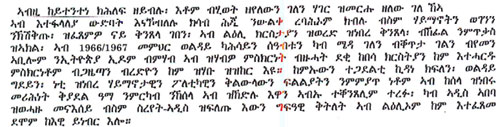
Source Tesfay 2004
- Source column 7, spans 11 columns
The ELF and EPLF leaders conspiracy of killing fighters in the 1970s and 1980s
Crimes comitted by the former revolutionary leaders after 1965
Editorial display title, based on preserved source evidence. Original titles are listed in Sources.
Title review remains pending.
Document-level source citation: [1]. Sources and local originals.
Research this document
Cite this document
The citation uses the editorial display title. Preserved source titles appear below. Author has not been established. Date has not been established. Numbered sources describe the whole document.
The permanent archive path is shown below. Add this local archive’s address when sharing outside this installation.
Author not established. Crimes comitted by the former revolutionary leaders after 1965 [editorial display title]. Date not established. EHREA archive: /library/documents/doc-f473df43318b350780086b5b/
[1] AFTER65.htm. Original source: http://www.ehrea.org/AFTER65.htm. Preserved original: /library/originals/a70aa8ac2bac06fae9cafdb71b3c789fe709c08eb369a849e4bb17c8a58f04ad.bin. SHA-256: a70aa8ac2bac06fae9cafdb71b3c789fe709c08eb369a849e4bb17c8a58f04ad
Compare with original
Download the preserved file and open it beside this reader to compare wording and layout. Preserved HTML can contain obsolete layout, missing images or legacy glyphs. Original HTML downloads are isolated by the archive’s sandbox download policy.
Download reader plain text · Derived from preserved HTML; use the reader for images and table structure.
Report a problem
This offline form saves on this device only. Download the report JSON and give it to your local archive curator for import. Nothing is sent automatically. Avoid personal contact details.
Document version and correction history
Current reader content signature: e53c34cf9b29bfc821d84b1eb302f04ffafb22d1c1af1055be06e74290376191. Source originals are preserved unchanged. Citation export format: ehrea-research-v1.
No imported correction reports are recorded for this document in this build. Drafts on a device are private and do not appear here.
A resolved report records curator review; its change reference identifies the separate guarded change. An imported report never edits historical text automatically.
Title, language and source notes
Current wording occurs as source prose, a fragment or an unconfirmed heading. Inspect original formatting and confirm a standalone title before clearing review.
Sources
These citations describe the document as a whole. Paragraph-level attribution has not been inferred.
AFTER65.htm
http://www.ehrea.org/AFTER65.htm
Preserved local original · source record
f473df43318b350780086b5bSHA-256:
a70aa8ac2bac06fae9cafdb71b3c789fe709c08eb369a849e4bb17c8a58f04adAll source URLs and preserved captures
- http://www.ehrea.org/AFTER65.htm
- http://ehrea.org/AFTER65.htm
- https://ehrea.org/AFTER65.htm
- https://www.ehrea.org/AFTER65.htm
- AFTER65.htm · earlier-capture
http://www.ehrea.org/AFTER65.htm
Local original
Same bytes as extracted source - AFTER65.htm · provisional-1
http://www.ehrea.org/AFTER65.htm
Local original · mirror/provided/www.ehrea.org/AFTER65.htm
Same bytes as extracted source - AFTER65.htm · refresh-2
http://www.ehrea.org/AFTER65.htm
Local original · mirror/generations/refresh-2/provided/www.ehrea.org/AFTER65.htm
Same bytes as extracted source - AFTER65.htm · refresh-3
http://www.ehrea.org/AFTER65.htm
Local original · mirror/generations/refresh-3/provided/www.ehrea.org/AFTER65.htm
Earlier/different preserved capture; not used for this reader body
Extraction and duplicate decision
Full-content signature: e53c34cf9b29bfc821d84b1eb302f04ffafb22d1c1af1055be06e74290376191
Alternate titles: AFTER65.htm · Crimes comitted by the former revolutionary leaders after 1965
- f473df43318b350780086b5b: retained: ambiguous extraction; automatic merging disabled. 1 proven template removals; 1 extraction flags retained in the ledger.