Modern Education Development, Challenges and Current State in Eritrea (1839 to 2016)
Compiled and researched by Resoum Kidane
Pt. 6c Tertiary education in post liberation (1991-2006)
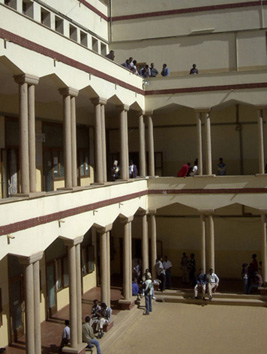
Brief Background information of Asmara University Pre independence (1962-1991)
On 20 December 1958 the University of Asmara (known as the Santa Famila University) was officially established and was recognized by the then Eritrean Government in 1959. The university changed its name from the Santa Famila to the University of Asmara after obtaining recognition from the Ethiopian government in 1964. Thereafter its recognition, the university began offering Associate Diploma programmes in the Arts, Commerce, and the Sciences which contributed to increasing numbers of students being enrolled between 1962 and1974. Before 1974, the number of students enrolled at the UOA exceeded 1,500, despite the boycott of the Zemetcha (Campaign for National Development through Cooperation) by students at Asmara University.
University of Asmara graduates in 1972
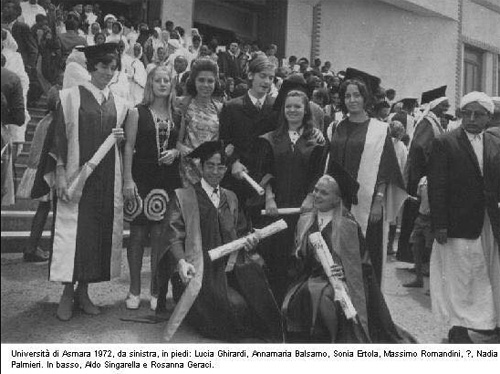
source researchomnia.blogspot.co.uk
When the Ethiopian Dergue government announced the Zemetcha (Campaign for National Development Through Cooperation) in 1974, the University of Asmara was shut down for more than a year, leaving only 349 students, a few Camboni sisters and two priests in residence..
Furthermore after 1975 the increasing levels of harassment and violence against educated Eritreans which contributed to declining numbers of students being enrolled at the UOA. According to Human Rights Watch Report during the Dergue period (1974-91) there were a number of egregious abuses against academic freedom at Asmara University which included the killing of Dr. Petros Habtemikael and of others. Human Rights Watch adds an earlier incident the killing, in 1975, of Dr. Petros Habtemikael, an economist.
Lemlem in her interviews mentioned that an Eritrean lecturer Dr. Petros had said in his lecture that Tigre was the oldest, then Tigrinya, then Amharic which provoked anger from Ethiopian students who wanted to hear that Amharic was the oldest. At the time the soldiers on their own initiative formed into a murder squad: they would kill people by electrocuting them with a wire round the neck. Dr. Petros was the first victim thereafter many other people were also killed [Wilson 71-72 page].
In 1975, in this climate of vilonce, the number of Asmara University students declined to 349 and still further during the Red Terror between 1977 and 1978. source University of Asmara (2012)
The school just limped along through the 1970s until 1979 when a new president pushed through a major reorganization of the curriculum and structure. After 1979, however, there was an increase in students from 300 to 2,700 when the new president pushed through a major reorganization of the curriculum. For example, the UOA granted its first undergraduate degrees in chemistry in 1980.
The launching of new courses such as chemistry; expanding campus buildings and developing the exchange of students and faculty members with the University of Addis Ababa, and especially the move to focus on graduate training there with the view to create a faculty such as faculty of natural science [1] https://en.wikipedia.org/wiki/University_of_Asmara helped to revive the university.
As a result of the above the number of students enrolled at the University of Asmara grew from 300 to 2,700, but with regard to the number of Eritrean students enrolled there was a decline due to a new quota system of admission.
There was, consequently, disproportion in the relative numbers of Eritrean and Ethiopian staff and students at the University of Asmara. More than 70 percent of teachers and 90 percent of students were not from Eritrea (a former Ethiopian province) but from Ethiopia.
However, the UOA went into decline again in 1988 when the EPLF started its military offensive from the northern province of Sahel and retook the town of Afabet which was then the headquarters of the Ethiopian army in north eastern Eritrea. The Dergue lost interest in supporting the University.
The university closed down most subjects, retaining programmes only in Marine Biology, Geology, and Arid Zone Agriculture. Finally, the Social Science courses were dismantled and moved in their entirety including faculty and staff to a rural area in southern Ethiopia. By 1990, the university was known as “Asmara University for the Northern Regions of Ethiopia”.(Africa Watch, 1993)
Furthermore when the EPLF intensified its attacks to Assab and put Asmara under siege, the university was transferred to Agarfa, south of Addis Ababa. After one semester the students were drafted into the military
As a consequence of the Dergue’s policy of dismantling the University of Asmara when the University was reopened after liberation, it was with very scarce resources and shortage of academic staff.
Asmara University in Post-independence 1991-2006
On October 10, 1991 the University of Asmara resumed its academic work with a few hundred students and five faculties, among them natural science and social science. In the earlier period of independence the Provisional Eritrean Government took steps to revitalize the University of Asmara in order to play a significant role in post-conflict rehabilitation, development and a sustainable peace.
Based on this initiative, in 1992, the university reviewed its academic programmes and curricula (Leonida 2004). Donatella Lorch(1993) also states that since it reopened, the turnout had been impressive. In 1992, there were 14,000 applicants for about 1,600 places in the freshman class (http://www.nytimes.com/1993/04/27/world/new-eritrea-restores-life-to-a-campus.html
Some achievements of the UOA 10 year strategic plan
In 1995 the university set up a 10-year strategic plan which aimed to rebuild the University of Asmara. To implement this strategic plan the university sent many its staff to pursue postgraduate studies in different institutions, some in USA, Europe, Australia, South Africa, through various links and assistantship programmes[.
Many of its staff who went for postgraduate studies returned to the country and contributed to the university’s teaching and research. The UoA, in earlier times had also produced brilliant students who later went on in further education. Additionally from the academic year 1992/1993 until the academic year 2002/2003, the number of students enrolled in day classes grew as can be seen from the table below.
- Source column 2, spans 9 columns
Students' Enrolment in University of Asmara
- Source column 1, spans 2 rows
Academic Year
- Source column 2, spans 3 columns
Degree
- Source column 5, spans 3 columns
Diploma
- Source column 8, spans 3 columns
Certificate
- Source column 11, spans 3 columns
Total
- Source column 2
F
- Source column 3
M
- Source column 4
T
- Source column 5
F
- Source column 6
M
- Source column 7
T
- Source column 8
F
- Source column 9
M
- Source column 10
T
- Source column 11
F
- Source column 12
M
- Source column 13
T
- Source column 1
1991/92
- Source column 2
223
- Source column 3
1619
- Source column 4
1842
- Source column 5
224
- Source column 6
551
- Source column 7
775
- Source column 8
-
- Source column 9
-
- Source column 10
-
- Source column 11
447
- Source column 12
2170
- Source column 13
2617
- Source column 1
1992/93
- Source column 2
348
- Source column 3
1248
- Source column 4
1596
- Source column 5
173
- Source column 6
391
- Source column 7
564
- Source column 8
-
- Source column 9
-
- Source column 10
-
- Source column 11
521
- Source column 12
1639
- Source column 13
2160
- Source column 1
1993/94
- Source column 2
252
- Source column 3
1824
- Source column 4
2076
- Source column 5
113
- Source column 6
249
- Source column 7
362
- Source column 8
-
- Source column 9
-
- Source column 10
-
- Source column 11
365
- Source column 12
2073
- Source column 13
2438
- Source column 1
1994/95
- Source column 2
338
- Source column 3
2496
- Source column 4
2834
- Source column 5
59
- Source column 6
186
- Source column 7
245
- Source column 8
-
- Source column 9
-
- Source column 10
-
- Source column 11
397
- Source column 12
2682
- Source column 13
3079
- Source column 1
1995/96
- Source column 2
317
- Source column 3
2526
- Source column 4
2843
- Source column 5
29
- Source column 6
81
- Source column 7
110
- Source column 8
-
- Source column 9
-
- Source column 10
-
- Source column 11
346
- Source column 12
2607
- Source column 13
2953
- Source column 1
1996/97
- Source column 2
252
- Source column 3
2474
- Source column 4
2726
- Source column 5
37
- Source column 6
329
- Source column 7
366
- Source column 8
15
- Source column 9
52
- Source column 10
67
- Source column 11
304
- Source column 12
2855
- Source column 13
3159
- Source column 1
1997/98
- Source column 2
360
- Source column 3
2304
- Source column 4
2664
- Source column 5
29
- Source column 6
343
- Source column 7
372
- Source column 8
5
- Source column 9
55
- Source column 10
60
- Source column 11
394
- Source column 12
2702
- Source column 13
3096
- Source column 1
1998/99
- Source column 2
471
- Source column 3
2832
- Source column 4
3249
- Source column 5
32
- Source column 6
537
- Source column 7
569
- Source column 8
37
- Source column 9
139
- Source column 10
176
- Source column 11
540
- Source column 12
3490
- Source column 13
3994
- Source column 1
1999/00
- Source column 2
519
- Source column 3
3074
- Source column 4
3593
- Source column 5
31
- Source column 6
386
- Source column 7
417
- Source column 8
42
- Source column 9
83
- Source column 10
125
- Source column 11
592
- Source column 12
3543
- Source column 13
4135
- Source column 1
2000/01
- Source column 2
596
- Source column 3
3407
- Source column 4
4003
- Source column 5
20
- Source column 6
422
- Source column 7
442
- Source column 8
45
- Source column 9
138
- Source column 10
183
- Source column 11
661
- Source column 12
3967
- Source column 13
4628
- Source column 1
2001/02
- Source column 2
636
- Source column 3
3897
- Source column 4
4533
- Source column 5
19
- Source column 6
505
- Source column 7
524
- Source column 8
84
- Source column 9
365
- Source column 10
449
- Source column 11
739
- Source column 12
4767
- Source column 13
5506
- Source column 1
2002/03
- Source column 2
613
- Source column 3
4201
- Source column 4
4814
- Source column 5
74
- Source column 6
515
- Source column 7
589
- Source column 8
86
- Source column 9
445
- Source column 10
531
- Source column 11
773
- Source column 12
5161
- Source column 13
5934
University of Asmara - Graduates of 1997 this videodedicate to Dr Fissha Ha
To some extent the university succeeded in achieving its mission by increasing the number of academic staff by allowing educated Eritreans in the diaspora to join the University and also by hiring new staff, giving opportunity to its staff to pursue post graduate study etc. As a result, of the 210 faculty members teaching at the university, 90 held PhDs. Of these 90, 38 (42%) were Eritreans whereas in 1991, only 8 (12.9%) of 62 faculty members held doctorates.
Furthermore the preliminary needs assessment which was conducted in 1995 indicated that there was a need for up to 1,000 persons trained at the Master’s level. Based on this recommendation in September 2004, the School of Graduate Studies took its first intake of 35 students in six fields of study: Agronomy, Horticulture, Applied Soil Science, Sustainable Livestock Production, Development Economics, and Organic Chemistry Of these. 27 graduated at the end of 2005/06 academic year.[source https://mpra.ub.uni-muenchen.de/11160/1/MPRA_paper_11160.pdf] [https://www.degruyter.com/downloadpdf/j/ci.2001.23.issue-4/ci.2001.23.4.97/ci.2001.23.4.97.xml [chemistry education]https://www.scribd.com/doc/30380227/University-of-Asmara-Graduation-July-1996]]
On July 2006, when the last batch (the 36th batch) of the UOA graduated there were 27 Masters Degree student who attended at the university on correspondence courses with Stony Brook University in the United States and a South African university. Between 1993 and 2006 the UOA not only achieved great success by increasing the number of students enrolled in Masters Degree, Degree, Diploma and certificate programmes but also produced thousands of responsible and hardworking students, for teaching in secondary and tertiary education, participating in research, and producing a workforce for various government departments, etc.
Regarding this (Rena (2007) states that since 1992, the UoA has supplied a workforce of about 9000 graduates, of whom more than half are graduates at the Bachelor level. The University remained committed to producing medium and high-level manpower that shared the supreme ideal of working in a spirit of commitment, understanding, and cooperation towards the common purpose of better serving the nation. https://mpra.ub.uni-muenchen.de/11160/1/MPRA_paper_11160.pdf)
During those years the university also became a major force for national development and progress through working on interdisciplinary research programmes in various projects such as the Eritrean Medicinal Plants Project, the Materials Science Project etc., and introducing a Student National Service Programme whereby students spent one academic year before graduation in providing services to the local community ;https://www.iupac.org/publications/ci/2001/july/eritrea2.html The University also contributed to the nation’s skilled manpower pool with 2,821 baccalaureate degree, diploma, certificate holders. Over 1200 civil servants attended an intensive 8 weeks of training at the management institute. Despite such contributions to development, the UOA was closed by the government in 2006. This raises the question: What was the motivation for the Eritrean government in closing the university of Asmara in 2006?
A brief timeline of the demise of Asmara University
A brief timeline of Asmara University’s demise [
After the Algeria ceasefire agreement between Eritrea and Ethiopia, the Eritrea National Assembly promised to hold elections before the end of 2001 but there was no support from President Isaias Afewerki for democratization. In order to divert the attention of the Asmara University students from focusing on democratization, the government introduced a summer work programme to repair roads, plant trees and work on construction.
However, the summer work programme provoked protests. The students called it slave labour. In the end the PFDJ ruling party suppressed the protests and the protesters were taken to an exceedingly hot place called Wia, 30 kilometres from port of Massawa. The temperature there was 49 degrees centigrade (120 degrees Fahrenheit). For more information read the testimony “theJourney from Asmara to Wia the Detention Camp” written by S.Y. in 2011.
- Source column 1
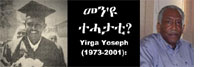

Yirga Yosef and Yemane Tekee, who both died of heat stroke, were students at Asmara University in the country’s capital. The 2,000 students were arrested and detained at the desert camp for refusing to sign up for a compulsory work programme organised by the People's Front for Democracy and Justice (PFDJ) government, and for demanding the release of the student union chairman Semere Kesete. readmore
The students were arrested either in their dormitories or outside the high court where they had gathered to attend a court hearing involving Kesete. They were kept overnight in a soccer stadium before being bussed out to Wia.
Samuel Tsegai (2006) states that after the university student opposed the summer work in 2001 in an organized way, PIA spent sleepless days and nights to dissolve the University of Asmara. Then he outlined many malevolent plans for the sake of dismantling the university.
From 2001 to 2006 the government had been apprehensive of the University of Asmara students which eventually led to its closure in 2006. This happened after 18th September when the hard -line leaders of the PFDJ cracked down on the reformist movement and arrested 11 of the G15group in September 2001. Since then the political situations in the country has also affected the University of Asmara.
After the government suppressed the students’ protest to the summer work programme it took measures to reduce student enrolment at the University to prevent further challenges to its authority. To implement this policy the Ministry of Education added one more year to the high school curriculum. Under the previous policy, after finishing 11th grade, students had to take the national examination and were sent to Sawa for military training. Those who passed the examination started their study at UoA and those who failed left to do their military service. http://www.nature.com/news/science-in-the-developing-world-eritrea-s-shattered-science-1.11671
In 2002 the university stopped new student enrolment and a year later the government decided to close the University of Asmara, with no new intake of student after 2003. The students that were already studying at the university were allowed to finish their degrees Since then, prospective students (those who score a passing grade in the National High School Leaving Certificate Exam) are directed to one of five tertiary education institutions that opened after the university was shut down. [https://en.wikipedia.org/wiki/University_of_Asmara] After completing their 12th grade in Sawa, students who pass their examination are transferred to the new technical college in Mai Nefi, opened in 2003. In the academic year 2003/2004 The University of Asmara did not enroll any freshmen
In 2004 the university was again informed that all the students who were finishing high school in Sawa would be sent only to Mai Nefi. The Mai Nefi College which was constructed with collaboration between the Ministry of Education and the Ministry of Defence began with about 5,500 students during the 2003-2004 academic year.{ https://en.wikipedia.org/wiki/Eritrea_Institute_of_Technology]]
In 2005, Isays Afeworki made clear during a visit to the University of Asmara that the staff should not be surprised if they don’t get any fresh students in the coming 4-5 years. Finally in July 2006 the last batch of students, 1,292, graduated in Masters Degree, Degree, Diploma and certificate programmes in different fields. The intention of Isays Afeworki, was made clear through his Education Minister, Osman Saleh, during a visit to the University of Asmara in 2005. The reason, he explained, that the University of Asmara should not expect to get any fresh students in the coming 4-5 years is that “we are in a transition period" and the University failed to produce the human manpower to accomplish local development needs.
This policy, promoted from the president’s office was in direct contradiction to the future Strategic Plan of Asmara University. The UoA expected[6] [p189], to grow up to 8000 day- students between 2005 to 2010, nearly a 100% increase from 1999/2000. The UoA’s plan for 1995 – 2010 was to excel in higher education and form a multi-campus, university system (CAMPUS) with junior colleges in different part of the country...
In 2005, a Cabinet Ministers’ meeting which underlined the need to strengthen the colleges of science and technology in the country expressed no concern over the future of Asmara University (Habtemariam, 2005) By and large between 2003 and September 2006 most departments in the University of Asmara were closing down with no further students and very few staff. For example, the Marine sciences department had only a laboratory technician and a graduate assistant. The research facility of the Marine sciences department in Massawa was taken over by the security agents of the government.
In September 2006, the University of Asmara was closed. The worst crime a government can commit in the sphere of education. In reality, as the only higher education institution with a near 50 year history in the country it qualifies for improvement and enlargement. ዩኒቨርስቲ አስመራ ብቐትሩ ጸልሚትዋreadmore
After the University of Asmara closed the various departments of the university with their staff were moved: the Social Science and Arts to Adi Keyh, the Agriculture Department to Hamelmalo; the Business and Economics Department to Massawa; and the Natural Science Department to Mai Nefhi. Paulos M. Natnael (2006) states that the destruction of an excellent educational system that had produced thousands of well-trained and well-prepared citizens was masterminded by the head of state who has never shown any interest in the prestigious University of Asmara, a two to three minutes ride from his office. Yet he has been shown celebrating a military graduation at the “College of Social Science” in Nakfa that is two days ride from his office.
Eritrea became, in 2006, one of the very few countries that is without a university , at a time when about 300 universities are operating in Sub-Saharan Africa. As Ravinder Rena [1] has argued, Eritrea’s level of creativity, its wealth and the future living standard of its people will be determined by the breadth and depth of its intellectual assets.
Despite the evident truth of this observation, the sole higher educational institution in Eritrea, the University of Asmara, which could have a key role in future economic and social developments, has been closed down. The demise of this institution is further proof of Issays Afeworki’s intense fear of intellectuals and above all of freedom of speech and democratic debate.
The demise of this institution is further proof of Issays Afeworki’s intense fear of intellectuals and above all of freedom of speech and democratic debate. https://www.youtube.com/watch?feature=player_embedded&v=4mPkfq93amg
መልእኽቲ ንተመሃሮ ነበር ዮኒቨርስቲ አስመራ read
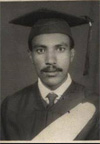

In memory of Medhanie Haile Afle, an Eritrean victim of brutal regime.
As a legacy of eliminating the intellectual stratum , after independence, staff and students of University of Asmara (Boa) became the next intended target of Afeworki. The authoritarian tendency of the president was evident on the (UoA) campus when Andebrhane Woldegeorgis was the president of Boa between 1991 and 1993.
At that time, the academic staff proposed to reform the University’s faculty association which had been established during the Dergue period. The aim was to show the strength of Eritrean intellectuals in meeting the needs of the newly liberated Eritrea and to re-establish the autonomy of the University.
Their proposal was rejected and they were informed that they were academically incompetent. The provisional government of Eritrea dismissed 40 lecturers (more than half of the faculty of the UoA). Many of those dismissed were dispersed into different ministries and became the executors of the EPLF’s political line. Among them were
Dr Tesfay, lecturer in the Department of Accounting who had challenged Andebrhane, ex-president of the university in the meeting.
Dr. Semera, lecturer in the Department of Physics
Mr. Iyob, lecturer in the Department of Biology who had a good reputation among the students for his teaching skills.
Dr Nugusse, lecturer in the Department of Economics
Father Vittorio Boria, mathematics lecturer and the Capuchin priest
Amanuel Melles, head of Marine biology also became the victim of the 1993 UoA staff dismissal. He subsequnetly emigrated to Canada in 1993 from Eritrea[https://en.wikipedia.org/wiki/Amanuel_Melles][ http://skillsforchange.typepad.com/npa_community/2010/12/2001-amanuel-melles.html
Dr Mohamed Kheir Omer who was member of committee that made decisions that seriously affected the university (not least the lives of 35 academic staff) and the country at large, openly testified that he collaborated with the regime in the process that led to the dismissal of the 35 lecturers. [readmore] This occurred at a time when the honeymoon of Eritrea’s liberation was at its peak, a stark difference than what we are exposed to now
Dr. Negusse Araya, Petros Habtemariam Mr. Michael Zaid Ghebremedhin who victims of 1993 Academic Staff Dismissal response to Dr Mohamed Kheir Omer)[ http://assenna.com/university-of-asmara-victims-of-1993-academic-staff-dismissal-a-response-to-dr-mohamed-kheir-omer/]
The above link is to a brief and account by a victim of this tragic action, correcting the record given by Dr. Mohamed Kheir Omer. In his article, Dr. Negusse Araya adds that it was at this stage that Dr Mohammed Kheir played a major role. He was behind the destructive mission of the President and worked hard to discredit the efforts of the Teachers Association of the university and to blackmail its executive committee, as well as those who support the ideals of the Association, by spreading false accusations and information. Read more
The repression of academic staff did not cease after Andebrhane tenure as president of the university between 1991 and 1993. In fact it got much worse during Dr Woldab, his successor, (1993-2006) when the University not only lost its autonomy but was placed under an autocratic administration and without a constitution . This caused dissatisfaction among many academic staff and resignations, such as by Professor Asmerom.
According to Berhane Habteab(2001) . Woldeab instead of maintaining the excellence, neutrality and independence of the academic environment, turned the university campus into a PFDJ mind-controlling institution. Berhane adds that Dr Woldeab Yisak is well known for his destructive leadership which reduced the academic standards at the university to a level no better than at a high school. By and large during Woldeab’s period the UoA came under still more intense pressure from the government particularly, in 2000, when the committee of university of students was expressing their opposition to the summer work. Source http://www.ehrea.org/threat.htm