Immature Interpretation of History Disrupts the Notion of Tolerance: Awate and the Foundation of Eritrean Armed Struggle in Focus.
http://assenna.com/immature-interpretation-of-history-disrupts-the-notion-of-tolerance-awate-and-the-foundation-of-eritrean-armed-struggle-in-focus/
Part One
Establishing well structured of historiography, what Eritrea missed for more than a couple of decades, allows various segments of the societies to develop a notion of tolerance understanding the roots, identity, culture, traditions, state foundation, nationalism, contributions, developments and failures as well. Genuine national history extracts the strength and the weakness of the state and helps to design workable, sustainable and productive policies which can bear the expected peaceful, united, democratic and developed Eritrea. Nonetheless, the frequent biases, omission, prejudices, and other errors in writing history often occur in Eritrea that bring confusion, misunderstanding and conflicts in various media outlets, academics and in various political parties or organizations. In fact most of the times interested groups attempt to manipulate historical facts to meet their desired objectives or to promote their cause using the tactics of selectivity, omission, distorting, and other forms of biases.
Currently, there is hot debate among different political parties, websites and individuals to define Hamid Idris Awate who began the long armed struggle for independence. The group can be mainly categorized into two sections: those who acknowledged Eritrean armed struggle for independence and those discredited the struggle for independence as false nationalism. Others may be free from such categories; they will not be in focus. In spite of the fact that there is no official declaration against the territorial integrity and sovereignty of Eritrea, there are different forms of tendency or campaigns are going to refute the armed struggle as a national struggle for independence, and questions the existence of Eritrea as sovereign state. Previously, I have produced an article, “History Is Not a Choice…” (www.unitedheartz.com) concerned about the general nature of Eritrean historiography that could help Eritreans to see their history from historical perspectives rather than using any form of political motivated interpretation.
Source: http://www.geschichteinchronologie.ch/afrika/kol/Eritrea-Munzinger-d/kriegsfoto01-beginn-widerstand-Hamid-Idris-Awate.PNG
On the occasion of the 51st anniversary of the launch of the Eritrean armed struggle, the Democratic Movement for the Liberation of Eritrean Kunama (DMLEK) led by Qornelios Osman, issues a statement which denied Hamid Idirs Awate as “national hero”. In its website, (www.mesel-biherat.com) the movement defined Hamid Idris Awate as criminal rather than national figure or icon. This statement provoked different political motivated feelings, opinions and interpretations flowing from various political parties, websites and individuals and many warned Qornelios Osman to apologize for his issued statement. In response, various groups underline Hamid Idris Awate as “National Hero”, “National Icon”, “Father of Eritrean Armed Struggle” etc. Some posted the snaps Hamid Idris Awate echoing “We are all Awate” (www.meskerem.net); Saleh “Gadi” Johar called for independent academic research (www.awate.com) to define who is who; and Merhawi Kinfu wrote an article “The Eritrean Revolution: Born A Shifta Father, Produced A Shifta System” which attempted to refute the struggle initially as “Islamic Movement” stating its attachment mainly with Iraq and Syria; and later transformed into “Barbaric and Criminal Movement” pointing out the dissolved groups like Hareka (Mahber 7), Obel, Menkae, Yemin and Falul (www.assenna.com).
Whether we like or not Hamid Idris Awate is a history, and his biography must be designed from historical perspective. If the history is genuine what we intend to do, it does not use or entertain with political oriented and motivated concepts like “Hero” or “Criminal”, because it is very hard to use a sort of description in history. Hamid Idris Awate might be hero for the people Bene Amir, but might be criminal for the people of Kunama in their eyes. The question here is: was Awate a “Hero” or “Criminal” in our history? Was he a “Shifta” or “National Icon”? There is an easy mechanism to respond such controversial question allowing to investigate the activities Hamid Idris Awate respecting time and space in history with the right context and analysis.
Once up on a time Awate was a “Shifta” having his own cause and motive and later transformed into a national fighter in history of Eritrean armed struggle. Nobody denies the first shot of Hamid Idris Awate sparked the long and bitter Eritrean armed struggle for independence. In fact the form, nature, character and motive of “Shiftnet” in Eritrea should not be viewed only from the side of the British Administration in Eritrea. We need a critical investigation on indigenous institutions which led to widespread banditry in Eritrea. Even though the coding of “Shifta” has negative implication in our society correlated with stealing or being outlaw, it can serve as means to protest against unfair system; and can serve as mechanisms to defend the defenseless people. Thus, “Shiftnet” has been viewed with different parameters and right context of that specified period of time, for example the political and socio-economic circumstances of 1940’s and early 1950’s. However, ill management of controversial concepts in history may lead to confusion and conflict complicated the process of building the culture of tolerance, harmony and unity among citizens.
Willingness to establish a democratic state is not enough without sincere and sustainable commitment. The essence of democracy could not emerge without building the culture of tolerance. In fact in circles of forbearance, there are various elements like patience, respect, equality, differences, will, knowledge, and culture which intermingled with each other to form a strong company of tolerance. The easiest meaning of tolerance is normally to accept and respect differences that could exist in race, religion, age, gender, opinions, and ideologies of other people or groups. Nonetheless, the nature and level of tolerance is different to different people who have different background, experience, educational level, personality and perception. Besides, we should not forget that there is a phenomena of zero degree of tolerance to any tendency which disrupts the national interest and national security, but it has to be done in more advanced and legal manner to build a safe state.
To be continued
Mebrahtu Teclesion
Part 2
http://assenna.com/immature-interpretation-of-history-disrupts-the-notion-of-tolerance-awate-and-the-foundation-of-eritrean-armed-struggle-in-focus-part-two/
Basically, the level of tolerance in most African states is least, because of various attributing factors- nature of state establishments, diversity in customs and tradition, level of education, chronic poverty, unbalanced distribution power and resource, undefined ideological systems, the nature of governance, less advanced technology and so on. But, I need to focus on the nature and level of tolerance in Eritrea considering the flow of conflicting information and feelings about veteran Hamid Idris Awate and the foundation of Eritrean struggle. Most of the time immature interpretation of history disrupts the notion of tolerance, and directs the state towards hatred, tension, division and conflict.
Partially, in my previous article, “History Is Not a Choice…”, I have dealt with some techniques of approaching history dedicated to historical perspectives (www.unitedheartz.com). Nonetheless, in this article, I need to shed some light on the causes, character and motive of “Shiftnet” in Eritrea on the basis of meager source that I have which can possibly eliminate the flowing irrational thinking, approach and analysis about the national history of Eritrea; and optimistically, that work may lead to further independent research. I could not narrate the history of “Shiftnet” in detailed form without having accessible source, but I concentrate on the systematic approaches that may help to shape our history. What best thing is that the British Archive documented in Research and Documentation Center of Eritrea is very rich; and this area is open to research, unlike the other areas, for example civil war in armed struggle for independence. The data are very vast and detailed; historians inside Eritrea can do deep research to eliminate such confusions. In fact some research papers about “Shifta” have already been done though it is not in my disposal.
So far the project of building tolerance and peaceful coexistence in African states produced less fruits, and most of them left in chronic sufferings, because of consistent internal crises and conflicts that destroy the synchronized social setting; that fail to build disciplined political interactions; and that lose skills, sincerity and dedication to foster economic progress. After Ethio-Eritrean conflict (1998), various interested group or politically motivated individuals have been seen to produce sensitive, emotional, divisive, provocative and biased literature without having access to valid, reliable, and objective sources. This unethical and immoral literature, produced without intensive research, can negatively affect the territorial integrity, harmony, unity, tolerance and sovereignty of the state, Eritrea.
Most of the time, the “abnormal” birth of the states in Africa, with the exception of Ethiopia and Liberia, baptized by colonialists emerged without wise consideration of tradition, culture, history, economic realities, and geographical linkages. Indigenous people who had/have the same history, culture, belief and origin found themselves in various states which complicate the solidarity, coexistence, justice, equity and tolerance of the modern states in Africa. We need to develop well disciplined and constructive approaches and analysis to establish a well concerted national history instead of practicing emotional, aggressive, hostile and provocative ill researched literatures that we are blindly producing. What do Eritreans benefit in struggle for changes?
In fact Eritrea has embraced nine or more ethnic groups which could not have the same history, belief, customs and traditions; we need to accept the diversity of the societies. In spite of its positive legacy, Italians practiced high degree of racism, discrimination, segregation, exploitation and oppression. Eritreans attempted to get better privilege and salary joining the Italian army which participated in various wars conducted inside Africa. But later with collapse of Italian Colonization, a substantial number of Eritreans had a great expectation from British occupation (1941) since they considered them as liberators, not colonizers.
The established British Military Administration could not manage the growing socio-economic crises in Eritrea resulted by destructive wars and prevailing social disorders. The new British system preferred to retain Italian human power in various positions to address the problems; Eritreans got confused, dissatisfied and protested in different forms, for example “Shiftnet”. Because of Second World War, many Eritrean children became orphan and homeless; a number of fathers became jobless, and failed to maintain their families. Hunger, frustration, despair, conflict, looting, robbery and crime invaded Eritrea; and began disrupting the whole social settings, values and norms of the societies.
source: http://www.ehrea.org/images/SHI.gif
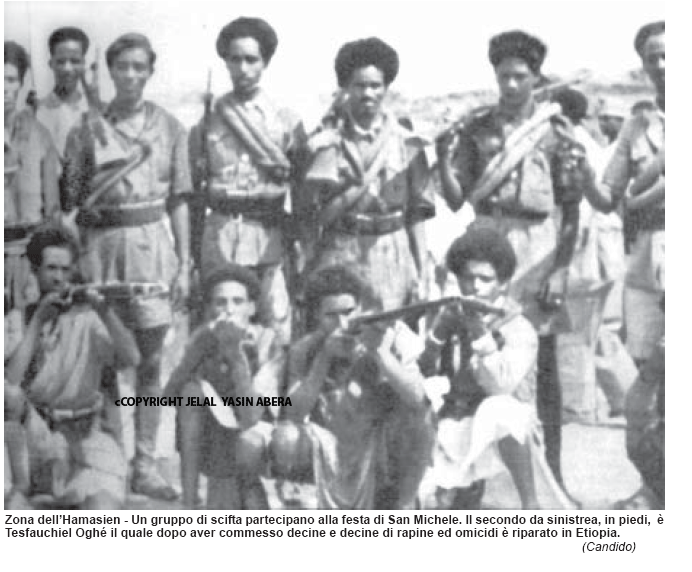
Despite of the fact that the British Administration introduced better education, reduced the scale of racism, established native courts, practiced free press, and allowed political pluralism, its occupation ended up with disgraced mission- dismantling and destroying almost all economic infrastructure of the country. Consequently, more than one hundred thousand Eritreans migrated to get better jobs in Ethiopia, and others dispersed in different countries. Besides, thousands of Eritreans became involved in “Shiftnet” or banditry for various purposes aimed at looting, robbery, revenge, and protection with or without political motivations.
In fact later, “Shiftnet” was being used as integrated political instruments to terrorize those who supported independence in 1940’s. As I stated earlier the forms, nature, distribution and task of “Shiftnet” have to be investigated distinctively and independently accounting the historical context of 1940’s and early 1950’s as the motive varied from individuals to individuals; from group to group, from village to village. They did have their own distinctive cause, whether it is blessing or cursing, to be bandits to confront the situation disrupted the life of the indigenous people. We can look at the extent and nature of the banditries posted as public notice by British Administration. This table has been taken from Assenna Website.
- Source column 1
No.
- Source column 2
Name of wanted man
- Source column 3
residence or tribe
- Source column 4
amount of rewards
- Source column 5
crime for which wanted
- Source column 1
1
- Source column 2
HamedIdrisAwate
- Source column 3
Antore
- Source column 4
£300
- Source column 5
Already notified
- Source column 1
2
- Source column 2
WeldegebrielMossazghi
- Source column 3
BerakitAbbai
- Source column 4
£200
- Source column 5
Already notified
- Source column 1
3
- Source column 2
BerheMossazghi
- Source column 3
BerakitAbbai
- Source column 4
£200
- Source column 5
Already notified
- Source column 1
4
- Source column 2
HagosTemnewo
- Source column 3
DebriAdiTsadek
- Source column 4
£150
- Source column 5
Already notified
- Source column 1
5
- Source column 2
AssreskhengeEmbaye
- Source column 3
Areza
- Source column 4
£100
- Source column 5
Already notified
- Source column 1
6
- Source column 2
OqbankielIjigu
- Source column 3
ShimanugusTahtai
- Source column 4
£50
- Source column 5
Already notified
- Source column 1
7
- Source column 2
GhebreTesfazien
- Source column 3
Deda
- Source column 4
£100
- Source column 5
Murder
- Source column 1
8
- Source column 2
DebbassaiAbraha
- Source column 3
Habela
- Source column 4
£25
- Source column 5
Murder
- Source column 1
9
- Source column 2
SebhatuDemsas
- Source column 3
Habela
- Source column 4
£20
- Source column 5
Murder
- Source column 1
10
- Source column 2
TekleAsfha
- Source column 3
Keranakudo
- Source column 4
£20
- Source column 5
Murder
- Source column 1
11
- Source column 2
KidaneDemsas
- Source column 3
Habela
- Source column 4
£20
- Source column 5
Murder
- Source column 1
12
- Source column 2
Teklehaimanot Sereke
- Source column 3
Kerenakudo
- Source column 4
£20
- Source column 5
Murder
- Source column 1
13
- Source column 2
BerheHabtezghi
- Source column 3
Mekerka (Anseba)
- Source column 4
£30
- Source column 5
Murder
- Source column 1
14
- Source column 2
WeldesellassieAdal
- Source column 3
Liban (Serae)
- Source column 4
£30
- Source column 5
Murder
- Source column 1
15
- Source column 2
AbrahaZemariam
- Source column 3
Zigib
- Source column 4
£25
- Source column 5
Murder
- Source column 1
16
- Source column 2
GrazmacIlfaiAsfha
- Source column 3
Keranakudo
- Source column 4
£35
- Source column 5
Murder
- Source column 1
17
- Source column 2
MegisteabSeum
- Source column 3
AdiQontsi
- Source column 4
£30
- Source column 5
Murder
- Source column 1
18
- Source column 2
BereketeabAndemikiel
- Source column 3
Deda
- Source column 4
£20
- Source column 5
Murder
- Source column 1
19
- Source column 2
TarakeWerede
- Source column 3
Tigrai (Ethiopia)
- Source column 4
£20
- Source column 5
Murder
- Source column 1
20
- Source column 2
AndemariamZere
- Source column 3
Debri (Liban)
- Source column 4
£20
- Source column 5
Murder
- Source column 1
21
- Source column 2
BerheLijam
- Source column 3
Deki-Dashim
- Source column 4
£20
- Source column 5
Murder
- Source column 1
22
- Source column 2
MedhinKahssay
- Source column 3
Irob (Ethiopia)
- Source column 4
£20
- Source column 5
Murder
- Source column 1
23
- Source column 2
AbrahaSuba
- Source column 3
Tigrai (Ethiopia)
- Source column 4
£20
- Source column 5
Murder
- Source column 1
24
- Source column 2
Girmazion (who was with Haile Abay)
- Source column 3
Tigrai (Ethiopia)
- Source column 4
£20
- Source column 5
Murder
- Source column 1
25
- Source column 2
MebrahtuTeklenkiel
- Source column 3
Haben
- Source column 4
£20
- Source column 5
Murder
- Source column 1
26
- Source column 2
GheremedhinKefela
- Source column 3
AdiEwur
- Source column 4
£20
- Source column 5
Murder
- Source column 1
27
- Source column 2
Omer Aluru
- Source column 3
{AsaEsan???}
- Source column 4
£20
- Source column 5
Murder
- Source column 1
28
- Source column 2
Khalifa Omer
- Source column 3
{Sukuru Are???}
- Source column 4
£20
- Source column 5
Murder
- Source column 1
29
- Source column 2
{???} Maleh
- Source column 3
Tigrai (Ethiopia)
- Source column 4
£20
- Source column 5
Murder
- Source column 1
30
- Source column 2
Issak Ali
- Source column 3
Tigrai
- Source column 4
£20
- Source column 5
Murder
- Source column 1
31
- Source column 2
Ali Idris
- Source column 3
Hanzer
- Source column 4
£20
- Source column 5
Murder
- Source column 1
32
- Source column 2
Ali Hudera
- Source column 3
Denkal
- Source column 4
£20
- Source column 5
Murder
- Source column 1
33
- Source column 2
Khalifa Ali
- Source column 3
Hazu
- Source column 4
£20
- Source column 5
Murder
- Source column 1
34
- Source column 2
Ali Omer
- Source column 3
Tigrai (Ethiopia)
- Source column 4
£20
- Source column 5
Murder
- Source column 1
35
- Source column 2
GirmayHailu
- Source column 3
Mog’o
- Source column 4
£20
- Source column 5
Murder
- Source column 1
36
- Source column 2
AmareEmbaye
- Source column 3
Areza
- Source column 4
£20
- Source column 5
Murder
- Source column 1
37
- Source column 2
Idris {Achem???}
- Source column 3
Barya tribe
- Source column 4
£20
- Source column 5
Murder
- Source column 1
38
- Source column 2
Gale anewri
- Source column 3
Kunama tribe
- Source column 4
£20
- Source column 5
Murder
- Source column 1
39
- Source column 2
Shababi Tana
- Source column 3
Kunama tribe
- Source column 4
£20
- Source column 5
Murder
- Source column 1
40
- Source column 2
Osman Longi
- Source column 3
Kunama tribe
- Source column 4
£20
- Source column 5
Murder
- Source column 1
41
- Source column 2
Abakair Gale
- Source column 3
Kunama tribe
- Source column 4
£20
- Source column 5
Murder
- Source column 1
42
- Source column 2
AgajeHaitin
- Source column 3
Kunama tribe
- Source column 4
£20
- Source column 5
Murder
- Source column 1
43
- Source column 2
Gale Ambi
- Source column 3
Kunama tribe
- Source column 4
£20
- Source column 5
Murder
- Source column 1
44
- Source column 2
{Achti???} Buzu
- Source column 3
Kunama tribe
- Source column 4
£20
- Source column 5
Murder
- Source column 1
45
- Source column 2
TekleGilagaber
- Source column 3
Deki-Shehai
- Source column 4
£20
- Source column 5
Murder
- Source column 1
46
- Source column 2
HabteGilagaber
- Source column 3
Deki-Shehai
- Source column 4
£20
- Source column 5
Murder
- Source column 1
47
- Source column 2
KidaneHabtue
- Source column 3
Deki- Shehai
- Source column 4
£20
- Source column 5
Murder
- Source column 1
48
- Source column 2
KeseteTesfaldet
- Source column 3
Deki-Shehai
- Source column 4
£20
- Source column 5
Murder
- Source column 1
49
- Source column 2
Fessehaye Fessehazion
- Source column 3
Deki-Dashim
- Source column 4
£20
- Source column 5
Murder
- Source column 1
50
- Source column 2
MelakeBeyan
- Source column 3
Dek-Dashim
- Source column 4
£20
- Source column 5
Murder
- Source column 1
51
- Source column 2
KeleteGherezghiher
- Source column 3
Deki-Dashim
- Source column 4
£20
- Source column 5
Murder
Asmara, 7th January, 1950 (Sgd) T.W FITZPATRICK.
Commissioner of Police and Prisons, Eritrea.
Source: Source: http://assenna.com/the-eritrean-revolution-born-of-a-shifta-father-produced-a-shifta-system/
- Source column 1
No.
- Source column 2
Bandits in terms of region
- Source column 3
Religion
- Source column 4
No. Bandits
- Source column 5
Total
- Source column 6
No. Bandits in Percentile
- Source column 1, spans 3 rows
1.
- Source column 2, spans 3 rows
Eritrean Lowlanders
- Source column 3
Moslems
- Source column 4
5
- Source column 5, spans 3 rows
12
- Source column 6, spans 3 rows
23.6%
- Source column 3
Christians
- Source column 4
None
- Source column 3
Unknown
- Source column 4
7
- Source column 1, spans 3 rows
2.
- Source column 2, spans 3 rows
Eritrean Highlanders
- Source column 3
Moslems
- Source column 4
None
- Source column 5, spans 3 rows
30
- Source column 6, spans 3 rows
58.8%
- Source column 3
Christians
- Source column 4
30
- Source column 3
Unknown
- Source column 4
None
- Source column 1, spans 3 rows
3
- Source column 2, spans 3 rows
Ethiopians
- Source column 3
Moslems
- Source column 4
1
- Source column 5, spans 3 rows
8
- Source column 6, spans 3 rows
17.6%
- Source column 3
Christians
- Source column 4
7
- Source column 3
Unknown
- Source column 4
None
This table analysis has been done to show primarily the nature and distribution of banditry among Eritrean ethnic groups as the accusation is coming Democratic Movement for the Liberation of Eritrean Kunama (DMLEK) which is ethnic based movement. Secondly, there is tendency from certain group or individuals to associate the Eritrean armed struggle for independence with “Islamic Movement”, and started without any “national agenda” stating that for example “Eritrean Revolution: Born A Shifta Father, Produced A Shifta System”. I attempted to display how the distribution of banditry religious wise which helps to investigate the armed struggle whether it is a national movement or Islamic one. However, this article has no any form of ethnic, region and religious inclination. I believe that Eritrea has a national problem which is knocking each family, and it has to be tackled at nation level.
According to the above stated public notice out of 23. 6% of wanted bandits in lowlands, 13.8% comes only from Kunama ethnic group. The whole ethnic groups in lowlands covered only 9.8%. Accounting that statistical information, members of Kunama society involved in Shiftnet more than any ethnic group in the lowlands. Out of the total report of the public notice, 58.8% of the wanted bandits comes from the highlands of Eritrea, mainly from Hamassien.
Shiftas in highlands actively engaged in systematic looting, terrorization, killing and mutilating the defenseless Jeberti of Serae, Saho of Hazomo and Kunama of Tokombia area (http://www.ehrea.org/images/SHI.gif). These bandits usually involved in cattle looting in Gash Barka areas in larger scale. Ethiopians, mainly from Tigray, also engaged in banditry covered 13.7%. In fact if we compare the involvement of Ethiopia in banditry was greater than the whole ethnic group in the lowlands as the figure in the lawlands was only 9.8%. If we see the public notice in terms of religion accounting the name of the bandits and location: Christians 72.6%, Muslims 11. 8% and Unknown 15.6%. Therefore, the Christian Highlanders involved in Shiftnet almost six times of Muslim community in the lowlands.
Therefore, according to statistical information of the public notice, the dominant bandits were the Kunama ethnic group in lowlands of Eritrea covered 13.8%, though the British Administration put huge reward for searching Awate who might be the most wanted person. Even though it needs deep research, it is very hard to say that the only Kunama ethnic group was victims of “Shiftas” or bandits as far as the treat coming from other ethnic groups is less in figure, though the figures could not give us clear information of thickness of the banditry.
On contrary, we should not forget the victims hurt by “Shiftas” activities coming from the side of Kunama people; it is wrong that DMLEK’s presentation which sounds that the only Kunama people are the victims of Hamid Idris Awate. In fact the concentration of “Shiftnet” was much higher and worse in the highlands and extended its damage to all areas in lowlands. Political motivated accusation only directed against Hamid Idris Awate intending to eliminate his role in national armed struggle is not fair and acceptable, because there must be an independent research which studies the gravity and magnitude of “Shiftnet” that caused horrible destruction, permanent fear, torture and death of many innocent people in different part of the country. Who were responsible for these devastations? Presenting Hamid Idris Awate as criminal and Kunama ethnic group as victims questions the validity of the accusation as far as the Kunamam societies were not free from the practices of “Shiftnet” which holds the greatest figure in the lowlands.
To be continued
Mebrahtu Teclesion