



Mysterious death of Tuku'e The ELF & EPLF leaders'crimes
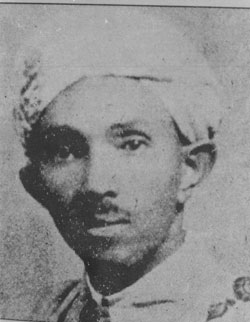
Crimes ELF and EPLF's victim civilians Mysterious death of Chekini


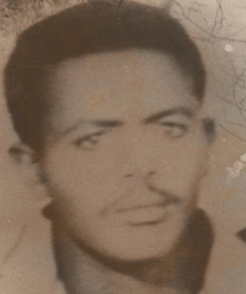
Mysterious death of Ibrahim Afa Mysterious death of Abraham Tewelde
2026-10-30
Fact and Evidence Part I: [1941-1952]
The struggled for Eritrean independence and role of political leaders
Introduction
The resistance of the Eritrean people led by Ras Woldenkeal against the Abyssian conquest in 1878, Kentebai Hamid against the Egyptian conquest , Hadgham Basah against the Italian occupation in 1891, and the uprising of Dejazmatch Bahata Hagos in 1894 opposing Italian rule, are well Documented historically by Bereketeab 2000, Killon 1991, Pateman 1990 and Paice 1994. The Eritrean Opposition against the Italian colonization also is documented in Tarik Hzbi Eritrea. Additionally the protest against colonialism during the Italian occupation contributed greatly to the rising of Eritrean nationalism and to the birth of the Eritrean political movement after the defeat of Italy by the British-led Allied forces in 1941. Although the Eritrean people being liberated from the Italian colonialism the British administration did little to free the Eritrean people from the Italian system. According Sherman (1980) during the first few years of the British occupation, disputes between Eritrean and Italians were still heard before Italian judges. Sherman (1980) adds that the British maintained the Italian law of racial discrimination and Protected Italian property which was contrary to the promise given to the Eritrean people. Trevaskis (1960: 51) also states that the Italian system remained for the most part unchanged and no Native courts were set up in Asmara until 1947.
Furthermore after the end of the war in 1943, the British Administration also offered concessions of land and other facilities to unemployed Italians to assist them in establishing industries , whereas the request of Eritrean who applied for land concession, import and export licenses, were refused. Pateman (1990: 59) states that from in 1941-1944, the British appropriated a further 10 000 acres of land and gave it to Italian settlers. The British had also rejected all the Coptic Church petitions for the return of the land Traveski( 1960:60). In addition to the above, Peter(1987: 50) mentioned that the British dismissed a number of Eritrean workers in the Italian administration. The British was also allowed the Italian administration to function as the same as before with the same staff, Pateman(1990:16) . In the British administration the Eritrean were not better off than the Italian colonization, and this led to dissatisfaction and the contention that the British favoured the Italians. Consequently the anti-Italian feeling increased in both the urbanized and rural population, and later the Ethiopian government began to exploit this feeling through the Coptic Church and pro-Ethiopians for the unity of Eritrea with Ethiopia. The involvement of the Coptic Church in campaigning for unity with Ethiopia in 1942 was documented by Sherman ( 1980:18), Trevaskis,(1960: 59), Spencer (1984: 196) and other historians. Additionally, Trevaski provided more explanations for the reason of the Coptic Church being involved in politics because of its belief that the union with Ethiopia could restore its property. The early resistance to colonization and also the political movement protest against colonialism in Eritrea, paved the road for the rise of the Eritrean nationalist movement in the1950s that later led to the formation of Eritrean Liberation Movement(Haraka). During British rule, five political parties were formed to claim immediate independence of the country. Eritrean women's political consciousness and participation started during this period (Cbaac, 2008).Example: ELSABET TEWELDEMEDHIN was Leader of the Women’s Unionist Party. (Throughout the federation period, a committee of three women led this women’s branch) ;TEMERTZA OGBAZGHI was leader of the Women’s Unionist Party. (Throughout the federation period, a committee of three women led this women’s branch) (Abera,2010)
Disunity of political leaders and the Eritrean independence question 1944-1950
- Source column 1
On 5th of May , 1941 Mahber Fikri Hager Eritrea (MFH)(Association for the Love of the Country of Eritrea) was formed to represent the Eritrean society in its daily interaction with the BMA through co-ordinating the relationships between the British Military Administration (BMA) and the Eritrean society. Gebremeskel Woldu (pro Ethiopia for the unity), Woldab Woldemariam (pro independence movement) , and Ibrahim Sultan (pro independence movement) were among its founder (Berketeab 146). (Makakis ). However, in 1944 the rift between the pro Ethiopia for the unity of Eritrea with Ethiopian and the pro -independence movement was exacerbated. This was happened when Haile Selasse sent Eritreans from Ethiopia to rename it as Yehager Fikr Mahber to instrument in its campaign to annex. This was resulting in the resignation not only of Muslim members but also of Christians such as Wolde-Ab- Wolde Mariam (Sorenson,305). Eventually, this caused for splitting of the Mahber Fikri Hager. The first signs of the split in the MFH became clear in 1944, when UNIONISTS dominated the association and the independentists started to abandon it.
- Source column 2
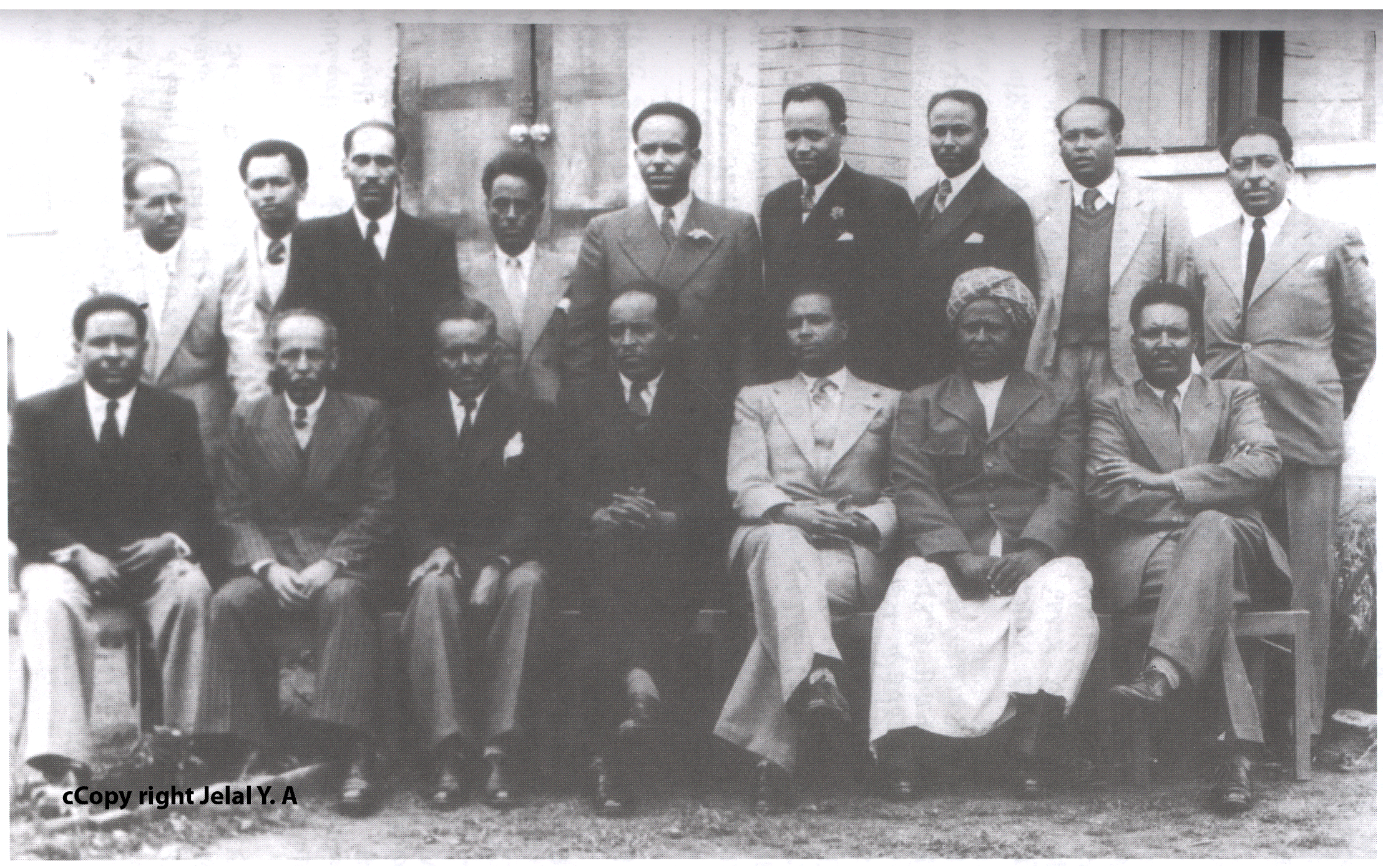
Addis Abeba-Resident Unionist(source Jelal Yassin)
- Source column 1
On November 22-26, 1946, a meeting was held in Bet Giorgis, Asmara,(locally known as The Waa’la Bet Gherghis the meeting of Bet. Giorgis) to resolve the conflict between the pro Ethiopia for the unity of Eritrea with Ethiopian and the pro -independence movement but it failed, this was because of the Unionist wing of the MFH rejecting Wold-Ab’s proposed compromise which gave a good opportunity for the unity between the Yehager Fikr Mahber and the unionist section of the Mahber Fikri Hager. After the meeting, the Unionist leader Gebremeskel Woldu who was one of the founder s of Mahber Fikri Hager was replaced by Tedla Bairu, the reason for Gebremeskel Woldu replacing was due to of the compromise agreement reached between the unionists and independence supporters.
- Source column 2
- Source column 1
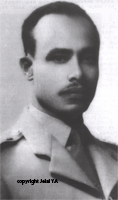
The Pro-independence and the Unionist reached a compromise in October 1946 to effect the “Eritrea should; be an autonomous state within the framework of the Ethiopian Empire. This agreement reached due to the absence of the Ethiopian liaison officer Colonel Negga Haile Selassie. On his returned from Addis Abeba in November 1946 not only the agreement was discarding but the chief advocate of the agreement and the Secretary General of the Unionist Gebremeskel Wold lost his post, Bereketeab (2000: 180), Killon (1991: 15]. (source for the photo Jelal Yassin)
- Source column 2
- Source column 1
- Source column 2
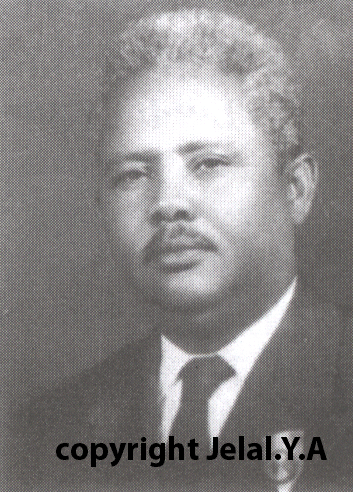
Colonel Nega Haile Sellassie: Born 1912. Shoan. Educated in Ethiopia and in France. Speaks French, a little English. During Italian occupation of Ethiopia went to the Sudan; returned to Ethiopia 1941. Was Secretary-General of Ministry of War and later Director of Public Security. In March 1946 appointed Ethiopian Government Liaison Officer in Asmara. Has notoriously used his position in Eritrea to further union with Ethiopia by means of propaganda and distributions of money. Although he personally directs the affairs of the party, he does not appear to be popular with Eritrean Unionists, particularly as he does not speak Tigrinia. Is a somewhat colourless personality. Has an implacable hatred of the Italians and is suspicious of the British. (source for the photo Jelal Yassin)
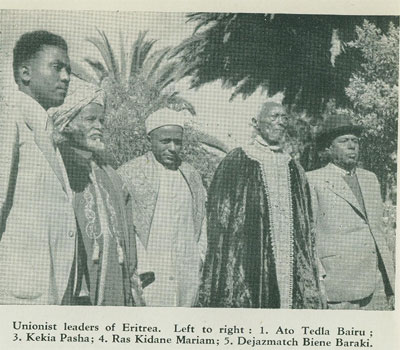
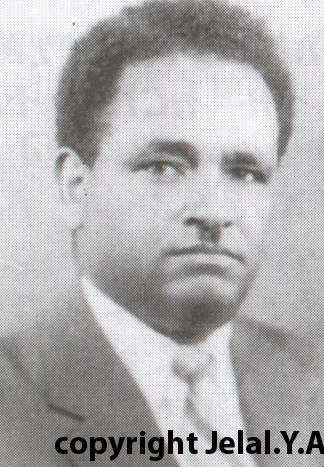
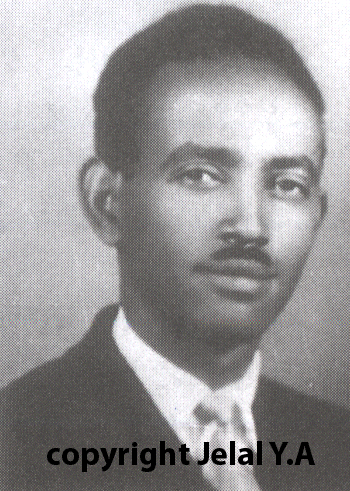
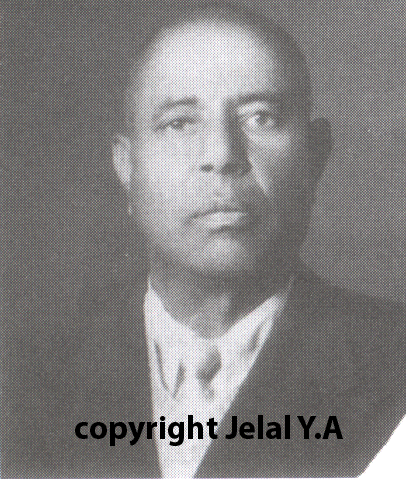
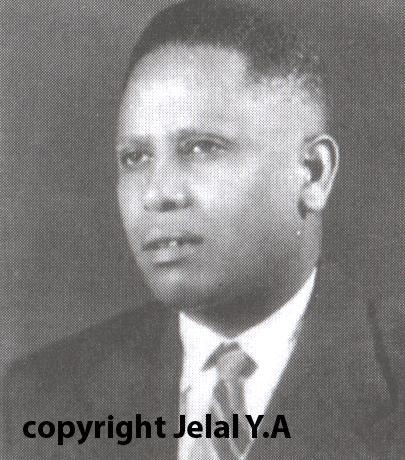
On December 3, 1946, Abune Markos appointed a new leadership consisting of Ras Kidanemariam Ghebremeskel (Honorary President), Dejazmact Beyne Beraki ( President, and Saleh Ahmed Kekiya ( Vice-president) and Ato Tedla Bairu as Secretary General, Fitawrair Taha Adem (Treasurer and Fitawrari Harego Abay ( Deputy Assistant Secretary).
- Source column 1, spans 8 columns
- Source column 1
- Source column 2
- Source column 3
- Source column 4
- Source column 5
- Source column 6
- Source column 7
- Source column 8
Deghiat-Harogot;FIT Solom; Ras Beyene; Deghiat-Ghebrehans; Degiat-Zerom ;Deghiat Embaye;Degiat Braki;Ras Kidane Mariam (copyright source Jelal .Yasin Aberra)
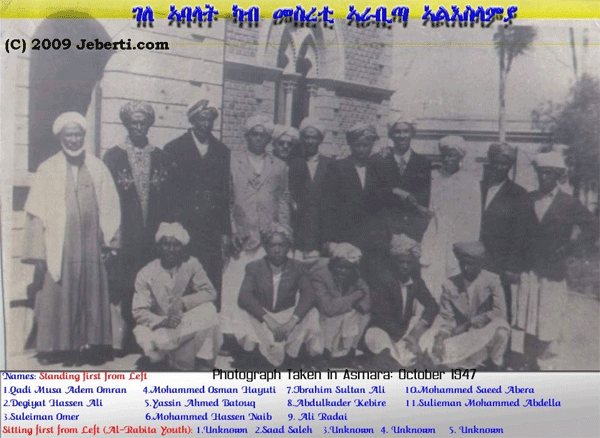
In reaction to the campaign union of Eritrea with Ethiopia, Ibrahim Sultan, called a meeting of all Moslem Communities to consider the question of Eritrea’s future in December 1946. According to Spencer (1984: 197) Moslem League was formed in Keren by Ibrahim Sultan,who was a spokesman for the serfs who sought freedom from the feudal Moslem landowners in the western plains of the Barca and Anseba valleys and in the eastern lowlands around Massawa
The Independence Progress Party IPP also known as the Liberal Progressive Party (LLP) was established in Adi Kheih for the creation of an independent Eritrean government. Ras Tesemma Asberom was elected President, Dejazmatch Maascio Zewede as Vice-president, and Grazmatch Seyoum Maascio as Secretary –General. Its aim was for the creation of an Independent Eritrean government free of any European control. As can be seen from Fig. 1 below, 1947 the following three political parties split from Mahber Fikri Hager: The Unionist Party , Moslem League, and Liberal Progressive Party. The UP was officially founded on March 21, 1947 by changing its name from the Association for the Union of Eritrea with Ethiopia changed its name to the Eritrea-Ethiopia Union Party.
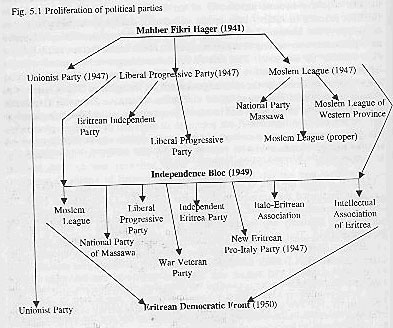
Source: Redie Bereketeab, 2000, p.148
- Source column 1

- Source column 2
In July 1948 the Moslem League were regrouping in Asmara and formed a coalation with a Kebessa political party the Liberal Progressive Party (LPP). Ibrahim Sultan and Seyoum Masscio, the LPP leader, then drafted a document and sent it by registered airmail to the UN. The document, in the name of 70% of the Eritrean population, rejected the union of Eritrea with Ethiopia. By 19477 Colonel Negga Haile Selassei, the Ethiopian Crown's representative in Asmera not only co-ordinated Unionist activity but was involved in bribery, intimidation and violence (Sorenson, 1991:305).
- Source column 1

- Source column 2
For example Ato Woldeab Woldemariam suffered severe wounds from an attempted murder on July 7, 1947. In August of 1948 the BMA's chief civil affairs staff officers was contemplating taking " action against Tedla Bairu and others, for the escalation of intimidation and violence" against pro-independence parties and individualist (Gebre-Medhin 1989:157p.). "...I also have in me the courage to die for my political beliefs, for the cause of liberty of my country, and for the genuine interest of my brothers and sisters." Woldeab Woldemariam in Hanti, Eritrea, Issue#, August 22, 195. There was also five assassination attempts on Knzmaa Berhzanu Hmdyn who was one of the founder of the Moslem League on 03/12/1946.
- Source column 3
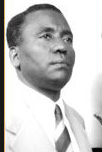
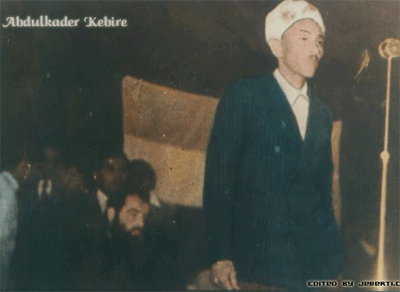
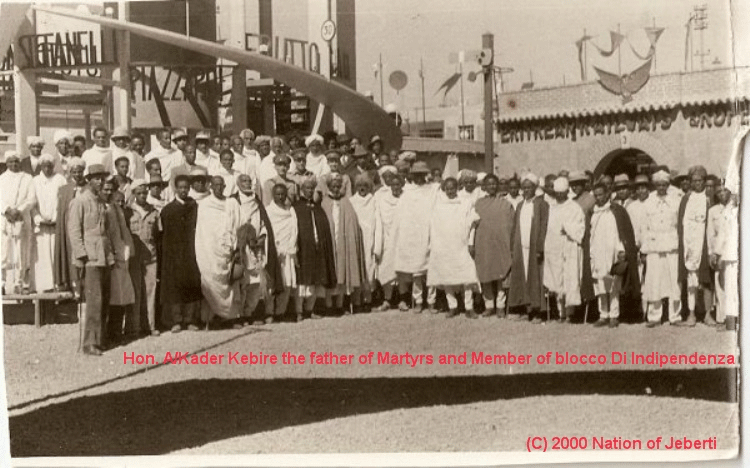
Regarding the political violence against the pro-independence party leaders and intolerance by the UP leaders, (Iyob, 1995:72) stated that, the UP’s new Secretary General, Tedla Bairu, proved to be authoritarian and intolerant. He was ruthless in eliminating opposition to the union with Ethiopia and attacked aggressively the ML and LLPs platform. Because of UP intolerance, Abdel Kadir Kebire, who was first vice president (1941-46) of the Mahaber Feqri Hager(MFH) and President of the ML-Asmara branch, was assassinated on March 30, 1949 on the eve of his departure to attend the meeting in Lake Success, New York, as well attacked on Dedjazmach Hassan Ali of the Moslem League by Unionists (Spencer, 1984:197) . SHIFTA provocation was assisted by the Keshi DIMITROS’
Despite all the intimidation, by the Unionist, the independence block group such as the ML, LPP, NPW, and NEPIP had never stop from demanding independence when the Four Power Commission of the UN visited Eritrea between November 7, 1947 and January 3, 1948. The anti- unionist movement and pro-independence formed a coalition known as the Independence Bloc(IB) on July 1949,with the aim of immediate independence of Eritrea and establishment of a democratic government.
After the formation of IB, followers of IB were intimidated by the Unionist Gheb Re-Ab (2009) states that one of the powerful Unionist organizations of the period in Asmara issued a decree. The purpose was to intimidate and harass the highl and population of Eritrea, most of whom are followers of the Orthodox Church, into opposing independence and supporting union with Ethiopia. The decree read as follows: We should have no association whatsoever with anyone in the Independence Bloc.
If there is any betrothal involving anyone with a family that has any association with the Independence Bloc, the betrothal should immediately be called off.
If anyone in the Independence Bloc is having a wedding, we should see to it that we do not attend the festivities or lend any of the traditionally obligatory support.
If anyone in the Independence Bloc or his family member dies, we should keep away from attending their funeral. If there is no one to bury them, however, no more than four people to carry the casket and three people to dig the grave should accompany the dead to the cemetery. This should be done only to avoid the outbreak of communicable diseases. NO PRAYER FOR THE DEAD SHOULD BE OFFERED BY ANY CLERGY; nor should any of the customary assistance (debes) be offered to the loved ones of the deceased.
Any clergy whose sympathy lies with the Independence Bloc must be removed from his parish. No believer should take confession, accept the sacrament of baptism or receive any blessings from such a clergy.
It was regrettable that by 1950 the IB had failed to achieve its goal as the Liberal Unionist Party led by Dedjazmatch Abrah Tessema, who supported a conditional union after receiving assurances from Ethiopia that the Eritreans would be left alone to manage their own affairs, and the Independent Eritrea United to Ethiopia Party (previously Independent Eritrea Party) split from the LLP. The Liberal Unionist Party led by Dedjazmatch Abrah Tessema, split from the LLP.
- Source column 1
Sheikh Ali Rada
- Source column 2
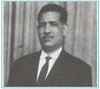
Idris Mohammed
- Source column 3
Sheikh Ali Radai leader of the National Party of Massawa who opposed Ibrahim Sultan’s leadership also split afrom the ML and established a separate party, the Independent Moslem League and joined the unionist camp (Iyob, 1995:77). In addition, when Idris Mohammed Adem and other groups of the nobility from the feudal Moslem landowners realized they were dominated by the serf emancipation movement seceded from the Moslem League. Following this, Kentebai Osman Hidad of Rora and Diglel Gelani of Beni Amer approached the Four Power Power Commision, pledging their support for a union with Ethiopia.
- Source column 4
Ibrahim Sultan
Generally, In the late 1940s, these political leaders of ML who split from League joined the Unionist party, instead of working together with the Ibrahim Sultan for Eritrean independence. As a result of the disunity of the political leaders and splitting within the Independence Bloc, finally the Independence Bloc changed its name to the Eritrean Democratic Front (EDF), 1950s. [see fig. 1]. On 2 December 1950 the UN adopted Resolution 390A(V) which provided that Eritrea Would become a federation with Ethiopia on September 11, 1952.
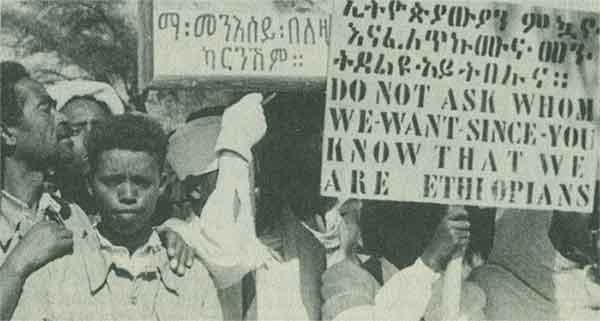
Tedla’s unwavering Unionist position and personal patronage network led to his unopposed election to the first Assembly for his home district of KARNISHEM. In March, 1952 the Eritrean Assembly elected Ato Tedla Bairu as President and Sheik Ali Radai as Vice-President of the Assembly, both of them from the Unionist party which played a great role in weakening Eritrean nationalism in the 1940s
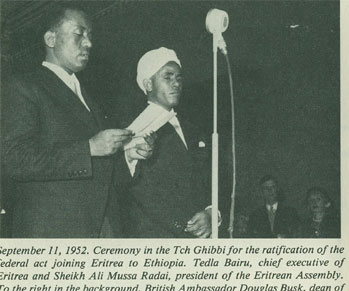
Leading Personalities in Eritrea (1950) By Source: British Archives - Jan 16, 2003
Fact and Evidence Part III: [1953-1959 ] The early development of the Independence struggle
ehrea
ehrea.org © 2004-2017. Contact: rkidane@talk21.com