Aster Ganno
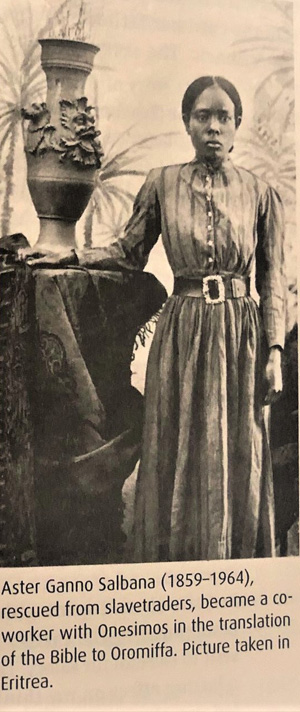
Aster Ganno (1872–1964) was Bible translator who worked with the better known Onesimos Nesib. She enslaved by the king of Limmu-Ennarea. She was emancipated in 1886 when Italian ships intercepted a boat which was taking her to be sold on the Arabian Peninsula, then took her to Eritrea where the Imkullu (Massawa), Eritrea school of the Swedish Evangelical Mission took her in. Aster (by Ethiopian custom, she is referred to by her first name) was educated at their school. Onesimos quickly “discovered that Aster was endowed with considerable mental gifts and possessed a real feeling for the Oromo language” (Arén 1978:383). She was assigned to compile an Oromo dictionary, which was first used in polishing a translation of New Testament published in 1893.
Aster also translated a book of Bible stories and wrote down 500 traditional Oromo riddles, fables, proverbs, and songs, many of which were published in a volume for beginning readers (1894). She later worked with Onesimos in compiling an Oromo hymnbook. Arén reports that a large amount of folklore she collected is still unpublished, preserved by the Hylander family (Arén 1978:384, fn. 71). Aster and Onesimos completed translating the complete Bible into Oromo, which was printed in 1899. The title page and history credit Onesimos as the translator, but it appears that Aster's contribution was not, and still is not, adequately appreciated. On April 13, 1903, Onesimus received a letter from Boji, Wellega, in which the pioneers told him that the evangelism work under the protection of two leaders was promising. At this news, he decided to leave Asmara, Eritrea and return to his country, because the journey was now easier thanks to the railroad built from Djibouti to Dire Dawa in 1902. So the Asmara congregation commissioned Onesimus, his family of four, Aster, and four other people as messengers to the Oromo on behalf of the church on December 6, 1903. The next day the entire congregation was there to send them off when they started their journey. Although Onesimus expected to meet Swedish missionary and personal friend Karl Cederqvist at the Port of Djibouti, that proved impossible. Onesimus and the group had to go on to Addis Ababa, because Cederqvist was behind schedule by six weeks. In 1904, Aster, together with Onesimos and other Oromos, were able to move from Eritrea back to wellega, where they established schools, Aster serving as a teacher at Nekemte.
source from facebook MY CHILDHOOD SCHOOL My Childhood Church