Dr. Reesom Haile
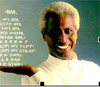
Dr. Reesom Haile was born in 1946 in Eritrea and died in 2003. Regarded as Eritrea's poet laureate, he returned to his native country of Eritrea in 1994 after a twenty-year exile.
Reesom Haile is from a family of traditional farmers in Eritrea, where he was born, raised and educated through high school. After working as a radio and television journalist in Ethiopia, he continued his education in the United States. Obtaining a doctorate in Media Ecology from New York University, he served for twenty years as a Development Communications consultant, working with UN Agencies, governments and NGOs around the world before returning to Eritrea in 1994. Since then, he has written over two thousand poems in Tigrinya. His first collection, waza ms qumneger ntnsae hager won the 1998 Raimok prize, Eritrea's highest award for literature. His first collection in English was We Have Our Voice (Red Sea Press, 2000), also recorded as a two-volume, bilingual CD (asmarino.com, 2001). His second collection was We Invented the Wheel (Red Sea Press, 2002). Widely published and recognized for his revolutionary modernization of the traditional art of poetry in Tigrinya, one of Eritrea's main languages.
Reesom Haile has begun to receive scholarly and critical attention and wide media coverage, including BBC (UK), CNN (USA), Deutche Welle (Germany), RAI (Italy), dmtsi Hafash (Eritrea) Radio Vatican (The Vatican), NPR (USA), SABC (South Africa), SBS (Australia) and VOA (USA). His performances in Tigrinya and English have inspired audiences throughout Africa, Europe and America. The enormous popular appeal of his poetry - in print and on the internet - is evident from the streets of Asmara to the far fields of the Eritrean countryside, where to stroll with Reesom Haile at any hour is to be approached by the young and old and all kinds of people who are delighted to quote his lines back to him.
Reesom Haile: the Lively Voice of Eritrea / la Voz Vivaz de Eritrea. Reesom Haile writes in Tigrinya. It is a Semitic language and, like the languages of Tigre and Amharic, derives from the ancient language of Ge'ez. It derives, like Hebrew and Arabic, from Aramaic, which is often thought to have been a language - along with Greek and Hebrew - of the original composition of much of the Old and New Testament and of Jesus.
The word "Ge'ez" also refers to the script of Reesom Haile's poems. It is Africa's most ancient and continuous, a 5000-year-old written language. It can be found, for example, on a stele in central Eritrea near the Ethiopian border. This stele was pulled down and run over by tanks, grinding it to pieces during the war between Eritrea and Ethiopia in 2000.
Source http://emnetu.com/Biographies/Dr.%20Reesom%20Haile/Dr.%20Reesom%20Haile.html read more
Poet Reesom Haile n interview with the Eritrean poet Reesom Haile. BBC
Resoum Haile writting
a bilingual edition of selected poetry by Reesom Haile with Charles Cantalupo, Africa World Press / Red Sea Press (Lawrenceville and Asmara: 1999), forthcoming.
Reesom Haile: The Quotable Poet of Eritrea
Blog post submitted by Marilyn Turkovich on Thursday, May 19, 2011 - 8:59am.
Voices is an affiliate of Amazon. A percentage of your purchase of books and other products sold by Amazon is given to Voices. Always go to Amazon by first opening your browser at Voice
by Charles Cantalupo, Distinguished Professor of English, Comparative Literature and African Studies, Penn State
Reesom Haile is from a family of traditional farmers in Eritrea, where he was born, raised and educated through high school. After working as a radio and television journalist in Ethiopia, he continued his education in the United States. Obtaining a doctorate in Media Ecology from New York University, he served for twenty years as a Development Communications consultant, working with UN Agencies, governments and NGOs around the world before returning to Eritrea in 1994. Since then, he has written over two thousand poems in Tigrinya. His first collection, waza ms qumneger ntnsae hager won the 1998 Raimok prize, Eritrea's highest award for literature. His first collection in English was We Have Our Voice (Red Sea Press, 2000), also recorded as a two-volume, bilingual CD (asmarino.com, 2001). His second collection was We Invented the Wheel (Red Sea Press, 2002). Widely published and recognized for his revolutionary modernization of the traditional art of poetry in Tigrinya, one of Eritrea's main languages, Reesom Haile has begun to receive scholarly and critical attention and wide media coverage, including BBX (UK), CNN (USA), Deutche Welle (Germany), RAI (Italy), dmtsi Hafash(Eritrea) Radio Vatican (The Vatican), NPR (USA), SABC (South Africa), SBS (Australia) and VOA(USA). His performances in Tigrinya and English have inspired audiences throughout Africa, Europe and America. The enormous popular appeal of his poetry - in print and on the internet - is evident from the streets of Asmara to the far fields of the Eritrean countryside, where to stroll with Reesom Haile at any hour is to be approached by the young and old and all kinds of people who are delighted to quote his lines back to him.
Reesom Haile writes in Tigrinya. It is a Semitic language and, like the languages of Tigre and Amharic, derives from the ancient language of Ge'ez. It derives, like Hebrew and Arabic, from Aramaic, which is often thought to have been a language - along with Greek and Hebrew - of the original composition of much of the Old and New Testament and of Jesus.
The Poems
Garden Eritrea
When the blood Of Eritrean men Floods Eritrea, Our heroes grow Again. When the blood Of Eritrean women Floods Eritrea, Our heroes grow Again. When the blood Of Eritreans Floods Eritrea, We grow back Again and again. Deny peace To Eritrea And you garden Eritreans.
Learning from History
We learned from Marx and Lenin: To be equal trim your feet For one-size-fits-all shoes. We made their mistakes, too. Equally, we all make mistakes. The evil is in not being corrected Aren’t we known By what we do, undo and do again?
The Next Generation
Well traveled and knowing many languages, The next generation arrives. Let’s rise to the occasion. Welcome, Vielkomen, Bien Venue, Ben Venuto! Let’s bathe your tired feet with hot water And serve the best injera, vegetables, meat and drink. Take this warm, white gabi to wrap yourself in. Let’s walk the mountains and valleys Given to us, we give them to you — History and culture to read, A legacy to satisfy your needs And to share, even with strangers — On one condition: Don’t give it all away. injera — traditional bread gabi — traditional blanket/cloak DestaDaughter, Desta, born in exile,
Desta
Daughter, Desta, born in exile.
Come home for a first time.
Meet your grandmother
Her family, her neighbors —
Your family, your neighbors,
Your country, our home.
Please eat
These vegetables and meat
And a special treat of wild roots.
Or have I spoiled you?
No, Daddy, I love this. But we need windows.
Knowledge
First the earth, then the plow: So knowledge comes out of knowledge. We know, we don’t know. We don’t know we know. We know we don’t know. We think This looks like that — This lemon, that orange — Until we taste the bitter.
All English translations by Charles Cantalupo
